The Collective Advantage: Inside Austin's Art Communities Built on Mutual Support
The mythology of the solitary artist — working in isolation, competing fiercely for gallery representation, collectors, and critical attention — has never fully described the reality of how creative communities actually function. But in Austin, a new generation of visual artists is not merely departing from that mythology in practice; they are actively constructing an alternative ethos in its place.
What is taking shape across the city's studios, shared workspaces, and informal gathering networks is a model of artistic community grounded in mutual support, transparent skill exchange, and a deliberate de-emphasis of competitive individualism. The artists building these communities are not naive about the market realities of professional practice. Rather, they have arrived at a considered position: that the long-term sustainability of their work is better served by collective investment in one another's success than by the zero-sum logic that traditional art market frameworks tend to encourage.
A Different Kind of Capital
To understand the appeal of this approach, it helps to think carefully about what artists actually need to sustain a practice over time. Financial income is essential, but it is far from the only form of capital that determines whether an artist continues making work ten or twenty years into a career. Knowledge, access, emotional resilience, technical skill, and professional networks are equally consequential — and these forms of capital are not naturally produced by competitive individualism.
Austin's emerging artist collectives are, in essence, systems for generating and distributing precisely these non-financial resources. A printmaker who shares her knowledge of archival paper sourcing with a painter in her network is not diminishing her own competitive position; she is strengthening the collective infrastructure from which everyone, including herself, draws. A sculptor who mentors a younger artist navigating their first public commission is building the kind of relational trust that, over time, creates durable professional bonds and referral networks that no amount of individual self-promotion can replicate.
This is social capital in its most functional form, and Austin's community-oriented artists are accumulating it with considerable intentionality.
Skill Circles and the Architecture of Exchange
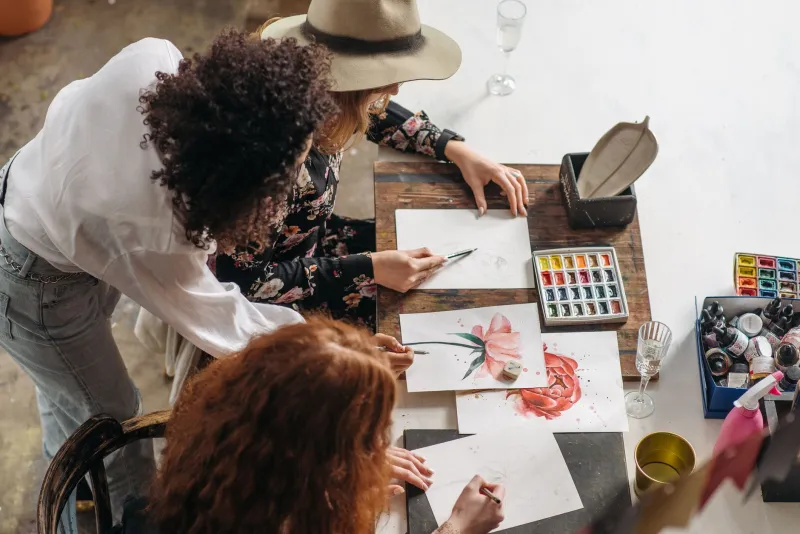
Perhaps the most distinctive structural innovation within Austin's mutual support networks is the emergence of formalized skill-sharing circles — recurring gatherings in which artists trade specific competencies across disciplinary lines.
These circles operate on a simple premise: every artist possesses knowledge that other artists need, and the most efficient way to distribute that knowledge is through direct peer exchange rather than expensive workshops or institutional programs. A photographer with deep expertise in licensing agreements shares her framework with painters entering the commercial market for the first time. A muralist experienced in public permitting processes walks installation artists through the bureaucratic landscape of city-commissioned work. A ceramicist with business acumen leads a session on pricing methodology for artists who have long undervalued their labor.
The content of these exchanges is practical and specific, but their effects extend well beyond the immediate transfer of information. Participants report that skill circles function as recalibration environments — spaces where the isolation of studio practice is briefly suspended, where professional anxieties are normalized through shared recognition, and where the collective intelligence of a diverse creative community becomes temporarily accessible to everyone present.
Mutual Aid as Market Strategy
It would be tempting to frame Austin's artist mutual aid networks purely as responses to economic precarity — safety nets constructed by artists who lack the institutional support that more established figures enjoy. That framing captures part of the reality, but it misses something important.
Many of the artists most actively engaged in mutual support networks are not operating from a position of desperation. They are mid-career practitioners with established collector relationships, exhibition histories, and sustainable studio practices. Their investment in community infrastructure reflects a deliberate philosophical orientation rather than a fallback position.
And the market effects of this orientation are, in many cases, measurably positive. Artists embedded in strong mutual support networks tend to receive more exhibition opportunities, because their peers actively recommend them for projects and residencies. They navigate professional challenges more efficiently, because they have access to collective wisdom rather than having to solve every problem in isolation. Their work reaches broader audiences, because community members cross-promote one another's exhibitions and events with genuine enthusiasm rather than performative obligation.
The paradox, which Austin's collective-oriented artists have largely embraced rather than puzzled over, is that choosing collaboration over competition appears to be good for individual careers as well as for the community as a whole.
Collector Relationships Transformed
The mutual support ethos is also reshaping how Austin's community-oriented artists engage with collectors. In networks where transparency and trust are foundational values, the collector relationship tends to become more intimate and more durable than transactional gallery interactions typically allow.
Collectors who enter these communities — often through invitations to skill circles, studio open days, or collective exhibitions — frequently find themselves drawn into something that feels less like a marketplace and more like a cultural conversation. They are invited to understand not just the finished objects available for acquisition, but the relationships, processes, and shared commitments from which those objects emerged. That deeper context tends to produce the kind of sustained collector investment that individual artists working in isolation rarely achieve.
Several Austin collectors who have developed relationships with community-oriented artist networks report that they have shifted their collecting behavior significantly as a result — purchasing more deliberately, engaging more directly with artists, and prioritizing the long-term support of creative practices over the acquisition of individual objects.
The Sustainability Argument
At its core, the mutual support movement in Austin's art community is making an argument about sustainability — not only the ecological sustainability that preoccupies much contemporary environmental discourse, but the professional and human sustainability of a creative life.
The art world's conventional competitive framework produces winners, but it also produces enormous attrition. Talented artists abandon their practices not because their work lacks merit, but because the isolation, financial instability, and emotional depletion of operating as a solo market participant eventually overwhelm the desire to continue. Austin's community-builders are constructing an alternative infrastructure designed to reduce that attrition — to keep more artists making work for longer, under conditions that honor the full complexity of a creative life.
The work emerging from these communities carries the texture of that investment. It is, in the most meaningful sense, art that knows where it comes from.