Open the Door: Why Inviting Clients Into Your Austin Studio Changes Everything
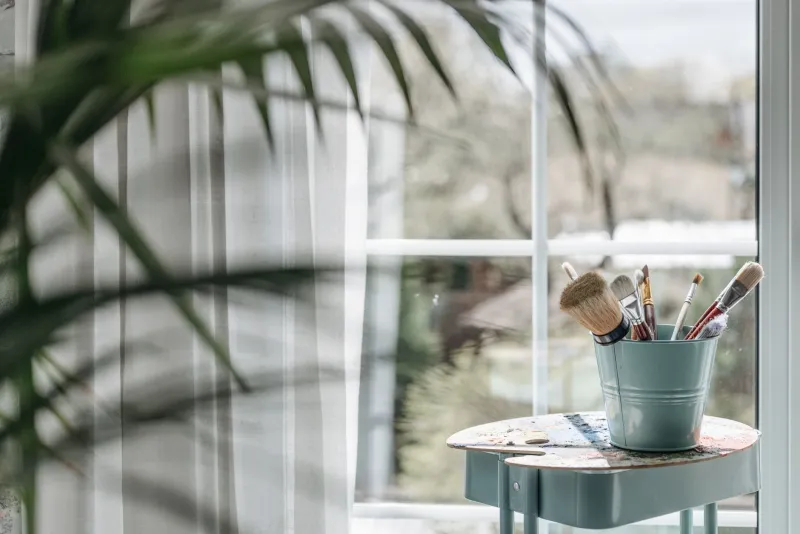
There's a moment that happens in almost every studio visit. A potential client walks in, looks around at the half-finished canvases, the paint-stained tables, the reference photos tacked to the wall — and something shifts. They stop being a buyer evaluating a product. They become a person stepping into a story.
In Austin, where authenticity isn't just a buzzword but practically a civic religion, that moment is currency.
The Portfolio Is a Highlight Reel. Your Studio Is the Reality Show.
Every artist curates their portfolio. You pick the strongest pieces, light them well, write clean descriptions, and present your best self. That's smart. That's necessary. But it also creates distance. A portfolio is a finished thing. A studio is a living thing.
When a client walks into your workspace, they see the mess and the magic at the same time. They see the color studies that didn't work. They see the reference materials you obsess over. They see you — not a polished version of you, but the actual human being behind the work. And that visibility? It builds a kind of trust that no website or Instagram grid can replicate.
Austin's creative community has figured this out in a big way. Artists across East Austin, South Congress, and the emerging creative corridors in North Loop have started treating studio visits as a core part of their client relationship strategy — not an afterthought.
The Psychology of Letting Someone In
Here's what's really happening during a studio visit: you're triggering what psychologists call the "reciprocity principle" and the "exposure effect" simultaneously. When you open a private space to someone, they feel trusted — and people who feel trusted tend to trust back. When they spend time surrounded by your work, in your environment, on your terms, familiarity builds. Familiarity builds comfort. Comfort builds commitment.
This is why artists who host studio visits consistently report that clients who come through the door are more likely to commission work, pay higher rates without negotiating hard, and come back for repeat projects. They're not just buying a painting or a design. They're buying into a relationship they feel like they already have.
Setting the Stage Without Faking It
Now, there's a fine line between creating an inviting environment and staging a performance. Clients can smell inauthenticity — especially in Austin, where the creative community has a pretty sharp radar for that kind of thing.
That said, there's nothing wrong with being intentional about how your space presents itself.
A few things that actually work:
-
Let the work-in-progress show. Don't clean up everything. Leave a piece on the easel or drafting table. Nothing starts a conversation faster than a client asking, "What's this one going to be?"
-
Have a clear focal point. Whether it's a statement wall, a collection of related pieces, or a material display that shows your process, give people somewhere to anchor their attention when they first walk in.
-
Make it sensory. Good lighting is non-negotiable. Beyond that, think about what the space smells like, sounds like, feels like. Austin artists who play ambient music, burn a candle, or even just have good natural light flowing in report that clients linger longer — and lingering leads to deeper conversations.
-
Keep something to pour. Coffee, sparkling water, local kombucha — it doesn't matter. Offering a drink is a social ritual that slows everything down in the best possible way.
Conversation Starters That Don't Feel Scripted
The best studio visits feel like genuine conversations, not sales pitches. But that doesn't mean you have to wing it entirely. Having a few natural entry points ready can keep things moving without making you sound like you're reading from a script.
Try questions like:
- "Is there a specific feeling or mood you're drawn to in the pieces you've seen so far?"
- "What's the space this is going into like? Tell me about it."
- "Have you ever been in an artist's studio before?"
That last one is surprisingly powerful. If the answer is no, you've just given someone a genuinely new experience — and people remember firsts.
Instagram-Worthy Doesn't Mean Fake
Let's be real: if your studio visit is visually compelling, clients are going to want to share it. That's not a bad thing. In fact, it's one of the underrated benefits of hosting visits. When a client posts a photo from your studio and tags you, they're doing your marketing for you — and doing it with the kind of authentic social proof that no ad can buy.
You don't need to design your studio around social media. But you can think about whether there are one or two naturally photogenic corners — a wall of work, a well-lit table, a view — that are easy to photograph. Keep those areas clean and intentional without making the whole space feel like a set.
Translating the Visit Into Higher Rates
Here's the business case in plain language: clients who have visited your studio understand your process. They've seen what goes into the work. They've watched you talk about your materials, your influences, your choices. That understanding makes it much easier to justify your pricing — because they're not just buying a finished object, they're buying everything they witnessed in that room.
Artists in Austin's commission market who've made studio visits a regular practice report that price objections come up less often and that clients are more willing to invest in larger, more complex projects. The studio visit doesn't just build trust — it builds perceived value.
Make It a Practice, Not a One-Time Event
The real power of the studio visit comes from consistency. Host a small open studio a couple of times a year. Invite past clients back to see new work. Make it part of how you operate, not just something you do when you're trying to close a deal.
Austin's creative scene rewards artists who show up as full human beings — who share their process, their community, their story. Your studio is the physical expression of all of that. Open the door. Let people in. The work that follows will speak for itself.