When Disciplines Collide: Austin's Artists Are Forging Creative Partnerships That Defy Easy Definition
Austin has never been a city that respects neat categories. Its music scene bleeds into its culinary identity; its tech corridor funds its arts infrastructure; its landscape informs everything from its architecture to the palettes of its painters. It is, in many respects, a city built on the assumption that disciplines are better understood as starting points than as destinations. That spirit is now manifesting in a remarkable wave of interdisciplinary artistic collaboration — and the results are challenging collectors, curators, and audiences to reconsider what contemporary visual art can reasonably claim to be.
The Friction That Produces Something New
Talk to any Austin artist who has stepped outside the comfort of their primary medium and you will hear the same word repeated: friction. Not the destructive kind, but the productive variety — the resistance that emerges when two distinct creative vocabularies attempt to communicate with each other. A painter working alongside a sound designer does not simply add audio to a canvas; the two practitioners must negotiate meaning, sequence, and sensory hierarchy in ways that neither would encounter working independently.
This productive tension is precisely what draws artists toward collaboration in the first place. When a visual artist partners with a composer, the question of how a painting might exist in time — rather than simply in space — becomes urgent and practical rather than merely philosophical. When an installation artist works alongside a structural engineer or architect, the constraints of load-bearing reality push the work into formal territory it could not have reached through imagination alone.
Across Austin's studio districts and creative hubs, from the East Side's converted warehouses to the collaborative spaces emerging near the Domain, artists are actively seeking out these productive collisions.
Visual Art Meets the Built Environment
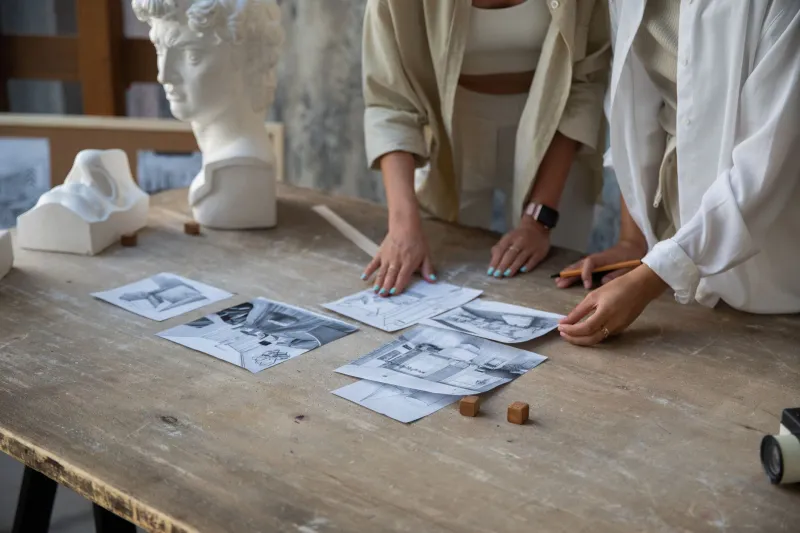
One of the most visible forms of interdisciplinary collaboration in Austin's contemporary art scene involves visual artists working alongside architects and spatial designers. These partnerships move beyond the familiar model of public murals commissioned to decorate finished buildings. Instead, artists are entering architectural conversations at the design stage — influencing material choices, spatial flow, and the relationship between interior light and exterior form.
The results occupy a productive ambiguity. Are they architecture? Are they sculpture? Are they installation art? In many cases, the honest answer is that the question itself has become irrelevant. What matters to the collectors and institutional clients drawn to these projects is the quality of experience the work creates — and that experience is often richer precisely because it cannot be comfortably categorized.
For Austin's visual artists, these architectural partnerships have also opened access to commissioning budgets that dwarf what the traditional gallery market typically offers. The financial logic of interdisciplinary collaboration, it turns out, can be as compelling as the creative logic.
Sound, Image, and the Hybrid Exhibition
Austin's identity as the self-proclaimed Live Music Capital of the World has made it a natural environment for visual-audio collaboration. But the partnerships now emerging between painters, sculptors, and musicians are considerably more integrated than a band playing at an opening reception. Artists across the city are developing works in which the sonic and visual elements are conceived simultaneously — each informing and complicating the other throughout the creative process.
These hybrid exhibitions are attracting audiences who might otherwise feel alienated by the conventions of the traditional gallery experience. A collector who regularly attends live performances at venues along Red River Street may find the white-cube gallery environment unwelcoming; an exhibition that incorporates live sound, spatial movement, and visual art creates a different kind of invitation. The work meets audiences in an experiential register they already understand, then introduces them to visual art through that familiar doorway.
For artists, the challenge is ensuring that neither discipline is subordinated to the other. The most successful collaborations treat sound and image as genuinely equal partners — not as a painting with a soundtrack, nor as a concert with decorative visuals, but as something that requires both to be fully itself.
Technology as Creative Partner, Not Tool
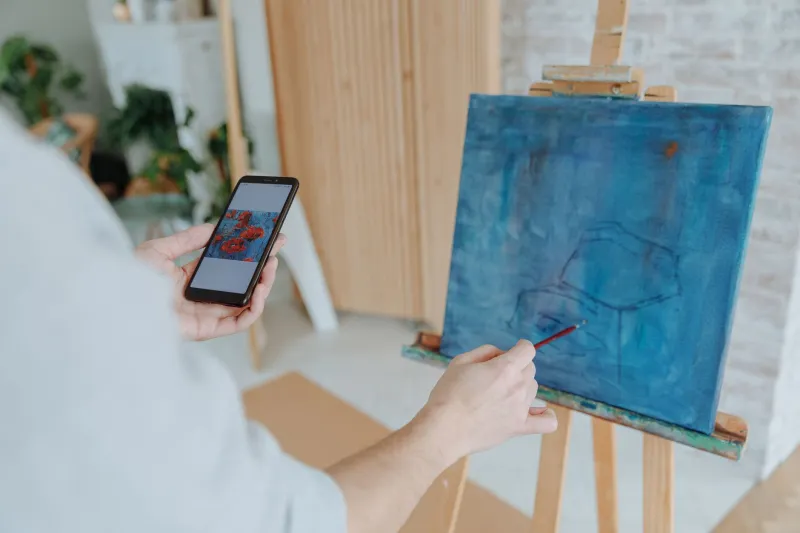
Perhaps the most rapidly evolving form of interdisciplinary collaboration in Austin involves visual artists working alongside technologists — software developers, interaction designers, and data scientists — to create works that respond to input, change over time, or exist simultaneously in physical and digital space.
These collaborations resist the temptation to treat technology as a medium in itself. The most thoughtful practitioners understand that code, sensors, and screens are instruments, not subjects — means through which visual ideas can be expressed with a dynamism that static materials cannot provide. When an Austin painter partners with a developer to create a work that shifts its color relationships in response to ambient sound levels, the underlying artistic questions remain painterly ones: How does hue communicate emotion? How does the relationship between colors change meaning? Technology simply allows those questions to be posed in real time.
Collectors engaging with these technologically integrated works face their own set of novel questions — around ownership, reproducibility, and the documentation of works that may behave differently each time they are experienced. Austin's art community is actively developing frameworks for addressing these questions, drawing on the city's deep reserves of both legal and technical expertise.
What Collectors Are Actually Buying
The collector appetite for interdisciplinary work is real and growing, but it is worth examining what drives it. In part, collectors are drawn to the narrative complexity of collaborative work — the story of how two or more practitioners from different disciplines negotiated a shared vision is itself a form of provenance that adds meaning to the object or experience being acquired.
There is also a genuine market logic at play. As the boundaries between art, design, architecture, and technology continue to blur in the broader culture, collectors who have built their holdings around purely medium-specific work are finding those holdings harder to contextualize. Interdisciplinary acquisitions, by contrast, speak to the present moment in ways that feel both contemporary and durable.
For Austin's artists, the practical implication is that collaboration is no longer a compromise or a departure from serious practice. It is, increasingly, the most direct route to the kind of work that serious collectors are actively seeking.
Austin as a Laboratory for What Comes Next
No American city is better positioned to produce genuinely interdisciplinary art than Austin. Its convergence of creative, technological, and architectural talent — concentrated in a relatively compact urban environment and regularly catalyzed by events like South by Southwest — creates conditions that are difficult to replicate elsewhere. Artists here do not have to travel far to find a musician, a developer, or a structural engineer willing to engage with a creative problem on its own terms.
What is emerging from these collaborations is not a unified style or movement, but something more valuable: a shared conviction that the most interesting work happens at the edges of disciplines, in the space where one creative vocabulary encounters another and neither emerges unchanged. For a city that has always resisted easy definition, it is a fitting artistic inheritance.