Canvas or Code: Austin's Visual Artists Confront the Age of Generative AI
There is a particular kind of unease that settles into a studio when the tools of the trade begin to change faster than the philosophy surrounding them. Austin's visual artists know this feeling well. Over the past two years, generative artificial intelligence has moved from a distant technological curiosity to a present and sometimes unsettling reality — one that raises questions about creativity, labor, and identity that the art world is only beginning to work through.
The conversations happening in Austin's studios, at artist residencies, and across shared workspaces are not simple. They do not resolve neatly into camps of enthusiasts and skeptics. They are, instead, the kind of conversations that reveal how deeply artists have always thought about what separates their work from mere image production — and how much that distinction now feels worth defending.
What the Machines Can Do
To understand why generative AI provokes such strong responses among visual artists, it helps to understand what these tools are actually capable of. Platforms built on diffusion models and large language model integrations can now produce images of remarkable visual sophistication in seconds. They can mimic specific artistic styles, generate compositional variations on a theme, and produce finished-looking work across a range of media — from oil painting aesthetics to graphic design to abstract expressionist gestures.
For artists who have spent years, sometimes decades, developing a visual language that is distinctly their own, this capability is not abstract. It is personal. Several Austin-based painters and illustrators have discovered their distinctive styles being replicated by AI systems trained, without consent or compensation, on images scraped from the internet — including their own published work. The legal dimensions of this issue remain largely unresolved, and the emotional dimensions are considerable.
The Integrity Debate
At the center of the conversation in Austin's creative community is a question that sounds simple but proves remarkably difficult to answer: does using AI in one's practice compromise artistic integrity?
The answer, as artists here will tell you, depends enormously on how the question is framed. There is a meaningful difference between an artist who uses generative tools as one element within a broader, deeply considered practice — as a form of reference, ideation, or visual exploration — and one who submits AI-generated images as wholly original work without disclosure. The former is an extension of a long tradition of artists incorporating new technologies into their process. The latter raises legitimate questions about honesty with collectors, galleries, and audiences.
What complicates the debate further is that the art world has never had a perfectly consistent relationship with the concept of authorship. Appropriation art, collage, photography, digital manipulation — each of these, at various moments in art history, provoked accusations that technology was displacing authentic human expression. Each was eventually absorbed into the broader definition of what art can be. Whether generative AI represents a similar evolution or something categorically different is a question Austin's artists are actively, and sometimes heatedly, debating.
Artists at Different Crossroads
The generational and career-stage dimensions of this debate are particularly visible in Austin, a city with a remarkably diverse creative ecosystem that spans emerging artists in their twenties through established practitioners with decades of exhibition history.
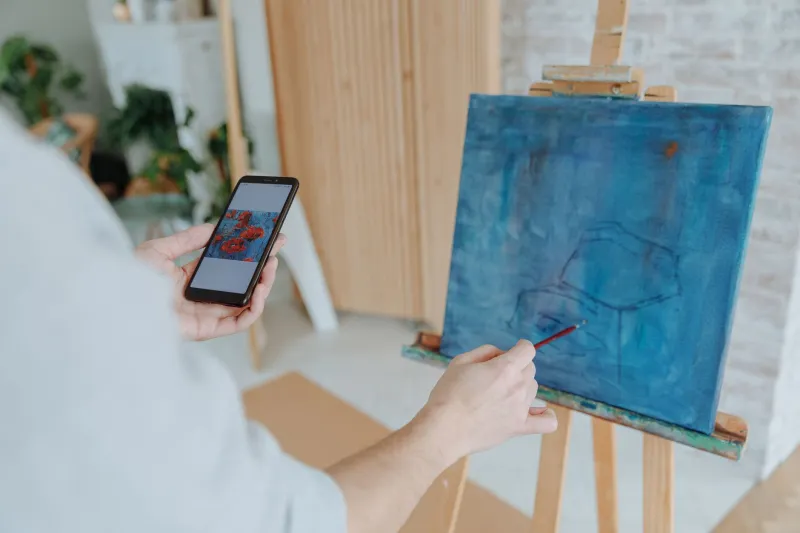
For younger artists who grew up with digital tools as a native part of their creative vocabulary, generative AI often feels less like an intrusion and more like an extension — another instrument in a toolkit that already includes Procreate, Photoshop, and 3D modeling software. Some describe using AI for rapid concept exploration before committing to a labor-intensive physical process, much as a sculptor might use a small maquette before working at full scale.
For mid-career and established artists, the calculus is frequently more fraught. The concern is not just about individual practice, but about the broader market conditions that AI is creating. If clients, commercial or otherwise, can approximate the aesthetic of a skilled illustrator or painter at a fraction of the cost, what happens to the economic foundation that sustains professional artistic careers? This is not a hypothetical anxiety — it is a material concern being felt across illustration, design, and certain sectors of fine art.
Disclosure, Transparency, and the Collector Relationship
One area where Austin's art community appears to be developing a rough consensus is around disclosure. Artists who use generative AI as part of their process — even in limited or supplementary ways — are increasingly recognizing an obligation to be transparent about that use, particularly in their relationships with collectors.
This transparency matters for reasons that go beyond ethics in the abstract. The contemporary art market, especially at the level where independent Austin artists typically operate, is built on trust and personal relationship. A collector who purchases a work believing it to be entirely hand-executed, only to discover that AI played a significant role, is likely to feel deceived — regardless of the artistic merit of the final piece. That breach of trust has consequences not just for the individual artist, but for the broader community of makers who depend on collector confidence.
Some Austin galleries and artist-run spaces are beginning to develop informal guidelines around AI disclosure, though formal policy remains rare. The conversation is evolving, and the standards that emerge will likely reflect the values of the specific communities and markets in which Austin's artists operate.
Toward a Practice-Centered Response
What is perhaps most striking about Austin's engagement with the AI question is the degree to which the most thoughtful responses are practice-centered rather than ideologically driven. Artists who are navigating this moment well tend to be those who have a clear, articulate sense of what their work is actually about — what questions it asks, what experiences it creates, what it requires of a human body and a human sensibility to bring into being.
For those artists, generative AI is neither salvation nor threat. It is a context — one that makes the specifically human dimensions of their practice more visible, and perhaps more valuable, precisely because the contrast is now so legible. The texture of a hand-mixed pigment, the decision-making embedded in a single brushstroke, the years of looking and failing and looking again that produce a distinctive visual intelligence — none of these are reproducible by a model trained on aggregated images.
Austin's contemporary art scene has always been defined by its resistance to easy categorization. The response to AI is proving no different. What is emerging is not a unified position, but a community of artists asking harder, more specific questions about what they make, why they make it, and what they owe to the people who receive it. In that uncertainty, there is something recognizably human — and recognizably artistic.