Learning to Look: A First-Time Collector's Guide to Entering Austin's Contemporary Art World
There is no formal credential required to become an art collector. No examination, no licensing body, no professional threshold to clear. And yet, for many people who find themselves standing in front of a painting or sculpture that moves them—genuinely moves them—and considering what it would mean to own it, the process of acquisition can feel opaque, even intimidating. The art world has historically done little to demystify itself, and Austin's contemporary scene, for all its accessibility and community spirit, is no exception.
This guide is intended for those at the beginning of that journey: individuals who have begun to engage seriously with Austin's contemporary art community and are navigating, for the first time, the transition from admirer to collector. It is not a financial primer or an investment strategy. It is, more fundamentally, an account of what it means to build a relationship with art and with the people who make it.
The First Encounter: Where Austin's Collectors Begin
For most first-time collectors in Austin, the entry point is not a gallery but an experience—a First Thursday on South Congress, a studio open house in East Austin, a chance encounter with a mural that stops them in their tracks. The city's art scene has always been unusually porous, offering points of access that more institutional markets in New York or Los Angeles do not.
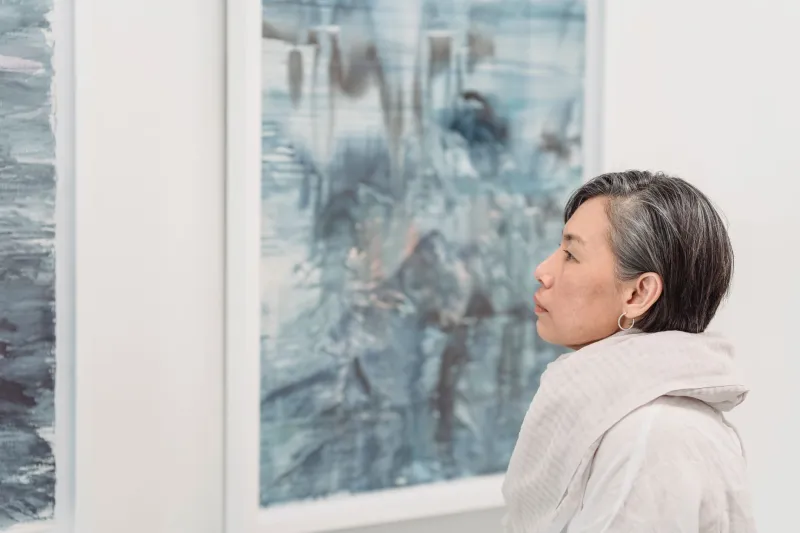
Sarah Montoya, a software project manager who purchased her first piece of contemporary art two years ago, recalls the moment that shifted her relationship to the local scene. "I'd been going to gallery openings for a couple of years just as social events," she says. "Then I walked into a show at a small space on East Cesar Chavez and stood in front of this large abstract painting for about fifteen minutes. I didn't want to leave. That was new for me."
Montoya's experience—the prolonged, involuntary attention that signals genuine connection—is one that many collectors describe as the catalyst for their first purchase. The challenge that follows is learning how to act on that response within a market that can seem designed to confuse the uninitiated.
Understanding Pricing in the Austin Market
One of the first practical questions confronting a prospective buyer is deceptively simple: how is a work priced, and is that price fair? Unlike most consumer goods, contemporary art carries no standardized valuation framework. Prices reflect a combination of factors—the artist's exhibition history, the scale and complexity of the work, the materials used, and the artist's established market—that are not always transparent to the outside observer.
In Austin's contemporary market, pricing tends to be more accessible than in major coastal cities, though this varies considerably depending on the artist's career stage and gallery representation. Works by emerging artists may be priced between a few hundred and a few thousand dollars, while mid-career practitioners with significant exhibition histories and institutional recognition command considerably more.
The most reliable way to develop a sense of pricing is direct engagement: attending multiple openings across different venues, asking gallery staff about price ranges, and following artists on social media, where many post work for direct sale. Austin's art community is, by reputation, unusually willing to discuss the economics of art-making with interested buyers.
"I was nervous to ask about prices at first," admits Montoya. "I thought it would reveal that I didn't know what I was doing. But the gallery staff I spoke with were genuinely helpful. They explained how the artist's work had developed, what made this particular piece significant within the body of work. That context changed how I understood the price."
Authenticity and Documentation
For first-time buyers, questions of authenticity and documentation are often sources of anxiety—understandably so, given the art world's history with forgery and misattribution. In practice, however, the risk of encountering fraudulent work in Austin's contemporary market is relatively low. The community is small enough that artists are generally known quantities, and most sales occur through channels—gallery representation, direct studio purchase, or established art fairs—that provide reasonable assurance of provenance.
That said, documentation matters, and responsible sellers provide it. A certificate of authenticity, signed by the artist, should accompany any significant purchase. This document typically includes the artist's name, the title, medium, dimensions, and year of completion. For works sold through galleries, invoices serve as additional provenance records and should be retained.
When purchasing directly from an artist—increasingly common in Austin, where many practitioners sell through their own platforms—buyers should request the same documentation and keep records of correspondence that confirms the sale. These records become important not only for insurance purposes but for any future resale or donation.
The Relationship Beneath the Transaction
What distinguishes authentic collecting from transactional purchasing, according to both collectors and artists in Austin, is the quality of attention and relationship that surrounds the acquisition. A collector who buys a work because it coordinates with their furniture has made a purchase. A collector who has spent time with an artist, understands the ideas animating the work, and has chosen a piece because it continues to reward sustained looking has begun something different.
For sculptor and painter David Reyes, who has sold work to collectors at various stages of their engagement with contemporary art, the distinction is palpable. "I can tell when someone is buying as décor and when someone is buying as a commitment," he says. "The commitment buyers ask different questions. They want to understand the work. They come back to the studio. They send messages when the piece is installed in their home. That relationship means something to me—it changes how I feel about where the work goes."
Reyes's perspective reflects a broader ethic within Austin's artist community: the belief that collecting, at its best, is a form of patronage in the oldest sense—a relationship of sustained support and genuine engagement between the maker and the keeper of the work.
Building a Collection With Intention
For those beginning to assemble a collection, the most consistent advice from experienced collectors and artists alike is to resist the impulse toward comprehensiveness and instead pursue depth. Rather than acquiring works across many styles and media, a collection built around a consistent set of interests—a particular relationship to material, a recurring set of themes, a commitment to supporting artists at a specific career stage—develops a coherence that makes it more meaningful over time.
Austin's contemporary scene offers unusual breadth for a city of its size: painters, printmakers, sculptors, installation artists, photographers, and practitioners working at the boundaries between disciplines. For the first-time collector willing to invest time in learning to look, it is an extraordinary place to begin.