Art That Talks Back: Austin's Contemporary Artists Are Making the Audience Part of the Work
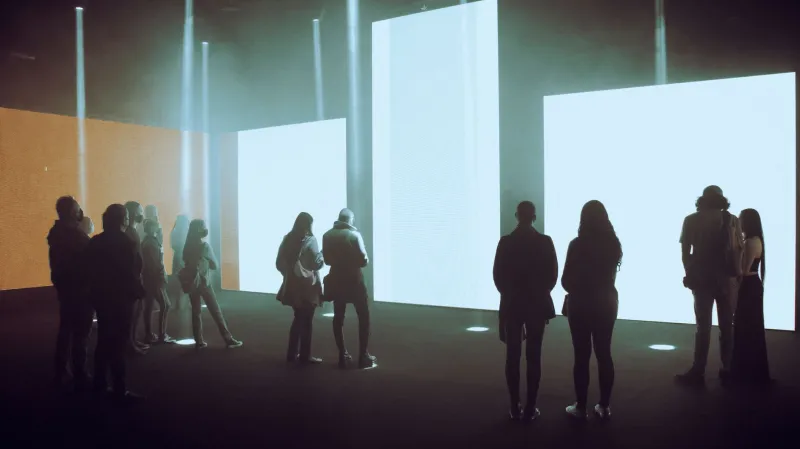
There is an old and largely unexamined agreement embedded in the gallery visit. You enter. You observe. You leave. The artwork remains unchanged by your presence, and you are expected to carry whatever meaning you extract in silence. For a growing number of Austin's contemporary artists, that agreement has become the very thing worth questioning.
Across studios, alternative spaces, and unconventional venues throughout the city, a distinct practice has been gaining momentum — one that treats dialogue, participation, and live exchange not as peripheral features of an exhibition, but as its primary substance. These artists are not simply inviting conversation. They are engineering it, structuring it, and in some cases insisting upon it as the only legitimate path into the work.
The Passive Viewer as a Creative Problem
The critique of passive viewership is not new. Relational aesthetics, participatory art, and social practice have long occupied serious territory within contemporary art discourse. What distinguishes the current moment in Austin, however, is the degree to which local artists are approaching this territory with deliberate craft — treating the architecture of conversation with the same rigor one might apply to composition, material selection, or formal structure.
For some practitioners, the problem begins with the gallery wall itself. The traditional white cube, whatever its merits as a neutral container, tends to reinforce a particular posture in its visitors: contemplative, self-contained, and fundamentally separate from the object of attention. When an artwork's meaning depends on what emerges between people — in the friction of differing interpretations, in the discomfort of being asked to speak rather than simply look — that architecture works against the intention.
The response, among Austin's dialogue-oriented artists, has been to redesign the conditions of encounter entirely.
Conversation as Medium
Several artists working in this vein have developed what might be described as structured conversation as a formal medium. Rather than producing objects that prompt optional reflection, they create situations in which exchange is unavoidable — sometimes scripted, sometimes improvised, but always intentional.
One approach involves embedding prompts directly into the physical installation. Text fragments, questions, or partial statements are positioned not as explanatory labels but as invitations to respond, either to the work or to other visitors. The artwork, in this framing, is incomplete until someone speaks. What gets said — and by whom, and to whom — becomes as much a part of the piece as the materials on the wall.
Other practitioners have moved further, eliminating the object altogether in favor of facilitated encounters. These works exist only in the duration of a conversation, and their documentation, if any exists, captures exchange rather than image. The artist's role shifts accordingly — from maker to designer of conditions, from author to host.
Austin as a Particular Context
Austin's cultural landscape offers a specific set of conditions that make dialogue-based practice both fertile and complicated. The city has long cultivated a self-image rooted in creative independence and civic participation, values that translate, at least in theory, into receptive audiences for work that asks something of them. The presence of the University of Texas, alongside a robust network of independent arts organizations, sustains a community accustomed to thinking critically about what art is and what it can do.
At the same time, Austin's rapid growth has introduced new pressures and new publics. The city's demographic transformation means that galleries and alternative spaces are increasingly navigating audiences with varied relationships to contemporary art — some deeply conversant with its conventions, others encountering experimental work for the first time. For dialogue-based practitioners, this heterogeneity is not an obstacle. It is, in many cases, the point.
When the work depends on what people bring to it — their histories, their assumptions, their willingness to be uncertain — a diverse audience becomes a richer medium. The conversation that emerges in a room of people with different backgrounds and different stakes is, by definition, more complex than one conducted among the already-initiated.
The Ethics of Participation
Not everyone who encounters participatory work arrives prepared for it, and Austin's dialogue-based artists are largely clear-eyed about the responsibilities this creates. Designing a situation in which participation is expected — or, in some configurations, required — raises genuine questions about consent, comfort, and power.
Several practitioners working in this space have spoken openly about the care involved in structuring encounters that are genuinely open rather than covertly directive. The risk in dialogue-based work is that the artist's intended meaning simply arrives through a different channel — that what looks like open exchange is, in practice, a guided path toward a predetermined conclusion. Resisting that tendency requires ongoing scrutiny of one's own assumptions and a willingness to let the work go somewhere unplanned.
This tension — between authorial intention and genuine openness — is, for many of these artists, the productive core of the practice. It is where the work actually lives.
Rethinking What the Gallery Can Hold
The implications of dialogue-based practice extend beyond individual exhibitions. When conversation is the medium, the traditional metrics of artistic success — the quality of the object, the coherence of the installation, the critical reception of the work as a fixed thing — become inadequate measures. What matters instead is the quality of the encounter: whether something real was exchanged, whether participants left differently than they arrived, whether the space held the conditions for genuine exchange rather than performed engagement.
For Austin's gallery ecosystem, this presents both an invitation and a challenge. Spaces that have been designed around the display of objects must consider how to accommodate work that exists primarily in time and exchange. Curators accustomed to thinking in terms of installation must develop new frameworks for presenting, contextualizing, and ultimately evaluating work whose outcomes are, by design, unpredictable.
Some of the most compelling dialogue-based work currently emerging from Austin's art community is happening precisely at the edges of conventional gallery programming — in borrowed spaces, in community venues, in configurations that do not announce themselves as exhibitions at all. The work finds its audience by being where people already are, rather than requiring them to adopt the gallery's particular posture of attention.
A Different Kind of Lasting
One of the more persistent questions surrounding participatory and dialogue-based practice concerns legacy. If the work exists in exchange, what remains? How does it enter a collection, a historical record, an institutional archive?
Austin's practitioners in this field tend to be pragmatic about the question without being dismissive of it. Some document extensively — capturing audio, video, or written accounts of exchanges as a record of the work's life. Others are deliberately indifferent to documentation, treating impermanence not as a limitation but as a formal position. The work happened. It changed the people who were in the room. That, they suggest, may be enough.
What is clear is that the conversation these artists are initiating — about what art is, what it does, and who it is for — is one that Austin's broader creative community is increasingly willing to have. And in that willingness, perhaps, is the most honest measure of the work's reach.