The Studio That Teaches Itself: Austin Artists Who Have Made Education Inseparable from Practice
The conventional narrative about artists who teach positions the classroom as a compromise—a necessary detour from the real work of making. In this telling, teaching is what happens when grants dry up, when gallery sales disappoint, when the economics of a creative life demand supplemental income. It is, in other words, a concession.
A different story is emerging in Austin. Across the city's independent studios, community arts centers, and private instruction spaces, a distinct cohort of working artists has arrived at a more nuanced understanding of what it means to teach. For these practitioners, education is not a detour from their practice. It is, increasingly, the practice itself—a mode of inquiry that sharpens methodology, generates unexpected discovery, and sustains a livelihood without requiring the artist to compromise the integrity of the work.
Articulation as Revelation
One of the most consistently cited benefits of teaching, among Austin artists who have integrated instruction into their professional lives, is the discipline of articulation. To teach a technique, a concept, or a way of seeing is to be forced into a clarity that solitary studio practice rarely demands. The artist must name what they do, explain why they do it, and anticipate the questions of someone encountering these ideas for the first time.
For ceramicist and workshop instructor Priya Nair, this process of verbal translation has been transformative. "I had developed an intuitive relationship with surface texture over years of working," she explains, gesturing toward the shelf of vessels that lines her East Austin studio. "I understood it through my hands, not through language. When I started teaching, I had to find words for something I'd never articulated. That process revealed assumptions I didn't know I was making—and opened up new directions I wouldn't have found otherwise."
This is a phenomenon that educators in other disciplines have long recognized: the act of teaching consolidates and deepens the teacher's own understanding. For visual artists, whose practices are often developed through accumulated physical experience rather than explicit theoretical frameworks, the effect can be particularly pronounced.
Building a Curriculum From a Practice
Not all Austin artists approach teaching with the same degree of integration. Some offer one-off workshops at local art centers or makerspace venues, providing instruction in specific technical skills—relief printing, encaustic painting, natural dye processes—without necessarily connecting those sessions to their broader creative inquiry. Others have developed more sustained educational programs that function almost as extensions of their studio research.
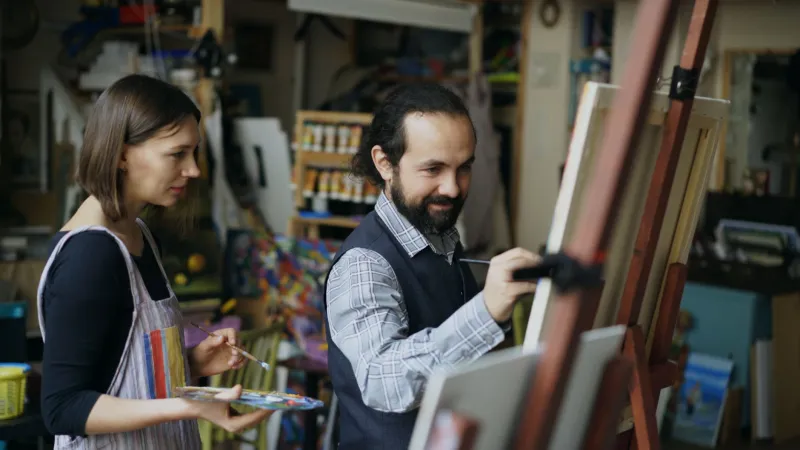
Painter and educator Marcus Webb has spent the past four years developing a curriculum around color theory and perceptual painting that draws directly from his ongoing body of work. His private instruction program, conducted from his studio in the Bouldin Creek neighborhood, has grown from a handful of students to a waiting list that extends several months. "The curriculum I teach is essentially the set of questions I'm working through in my own paintings," he says. "When I introduce a concept to a student and watch them struggle with it, I understand the concept differently. They make me smarter."
Webb's approach illustrates a key distinction between teaching as survival mechanism and teaching as practice integration. In the former model, the classroom and the studio exist in separate compartments—one funds the other, but they do not communicate. In the latter, the exchange is bidirectional and generative.
The Economics of the Teaching Practice
It would be disingenuous to discuss teaching without acknowledging the financial dimension that motivates many Austin artists to pursue it in the first place. Gallery sales remain unpredictable. Grant funding is competitive and cyclical. The cost of maintaining a studio in a city experiencing sustained economic pressure has risen considerably. Teaching, in this context, offers something that few other income streams can: regularity.
"I know what a workshop brings in," says mixed-media artist and instructor Dani Flores, who leads monthly community workshops at a nonprofit arts center in North Austin as well as private sessions from her home studio. "I can plan around it. That predictability changes everything about how I approach my studio time. I'm not making work with one eye on what might sell. I'm making the work I need to make."
Flores's observation points to a counterintuitive dynamic: by securing a reliable income through teaching, she has effectively insulated her studio practice from the market pressures that can distort an artist's creative decision-making. The workshop pays the rent so that the paintings do not have to.
This financial architecture—using education to subsidize creative autonomy—has become an increasingly common strategy among Austin artists navigating the gap between critical recognition and commercial sustainability.
What Students Give Back
Beyond the economic and methodological benefits, Austin's teaching artists describe a less quantifiable but deeply felt dimension of the educational relationship: the energy that students return to the studio.
"Students ask questions I would never think to ask myself," reflects Nair. "They're not burdened by knowing what's supposed to be difficult. They just try things. Sometimes what they try is wrong in a way that's actually interesting—it opens a door I didn't know was there."
This quality of beginner's mind—the unencumbered curiosity that characterizes learners at early stages of development—can serve as a genuine creative stimulus for the practicing artist who has spent years refining and narrowing their approach. The classroom becomes, in this sense, a laboratory for the kind of open-ended experimentation that established practice sometimes forecloses.
For Webb, the pedagogical relationship has become inseparable from his identity as an artist. "I don't think of myself as a painter who teaches on the side," he says. "I think of myself as someone whose practice includes making, thinking, and teaching. They're all part of the same conversation." In Austin's evolving creative economy, that conversation is growing louder—and the work it produces is all the richer for it.